






 o Wiccans,
trees are living, sacred Beings. Coven
Oldenwilde
is horrified by their slaughter in our region to make way for
ugly, sprawling developments for a wealthy elite. And as
Americans, we're disgusted by the
control greedy developers undemocratically exert over corrupt local
governments.
o Wiccans,
trees are living, sacred Beings. Coven
Oldenwilde
is horrified by their slaughter in our region to make way for
ugly, sprawling developments for a wealthy elite. And as
Americans, we're disgusted by the
control greedy developers undemocratically exert over corrupt local
governments.
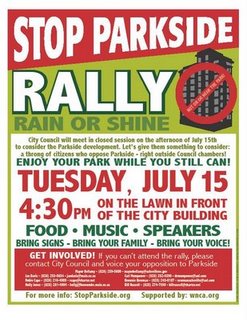
In summer 2007, we and other Buncombe County, N.C. citizens were outraged to learn that the previous fall the county manager and commissioners had blithely sold a chunk of our City-County Plaza park land in front of Asheville's iconic City Hall to developer Stewart Coleman, who wanted to build an enormous condo/retail complex on it.
Not only was this back-alley deal immoral and probably illegal, as it violated the terms of the 1901 deed in which philanthropist George Willis Pack donated the land in perpetuity to the people — and county officials didn't even know the parcel's boundaries when they sold it (at half of its assessed value) — but the proposed development would also destroy a majestic pair of old magnolia trees that are beloved countywide.
By Lammas, when no one else had stepped forward to shine a public spotlight on the situation and stop it, we of Coven Oldenwilde knew we had to act.
Clear-cutting and runaway overdevelopment are worldwide crises, so we hope you'll take a page from our spiritual activism, using similar creative, effective methods to help your own community. Real magic works: Not only did we succeed in saving both the magnolia tree and the historic Hayes-Hopson Building next door (today the thriving Pack's Tavern), but our "Magnolia Summer" in 2008 caused a seismic shift in Asheville's politics, breaking the backroom elite's decades-long grip on the city and empowering its progressive, environmentalist, and pro-neighborhood people.
- View on this page Lady Passion's article, Magnolia Summer: Spiritual Techniques for Protecting Your Environment, and a series of updates on the Magnolia Tree story, from oldest to most current.
- Explore our Magnolia Summer Activist Archive for the full fascinating saga, including photos, news stories, video links, co-organizer Clare Hanrahan's "Asheville On the Ground" daily blog from beneath the magnolia tree, and much more.
- Browse the Magnolia Summer Art Exhibit & Online Gallery of photos, art, poems, etc. inspired by the Magnolia Tree and created by members of the Asheville-area community.

 Magnolia
Summer
Magnolia
Summer
Spiritual Techniques for Protecting Your Environment
by Lady Passion
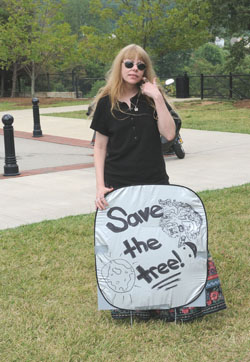
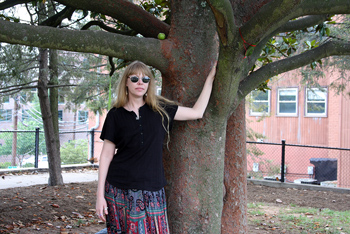
Sometimes you have to sit down to stand up for your spiritual ideals — go out on a limb to save an endangered tree, brave public scrutiny and risk ridicule, backlash, and failure to win a righteous cause. *Diuvei and I recently proved this theorem true when we spent 2 1/2 months living beneath an ancient magnolia, striving by Witchy will alone to save it from a rapacious condo developer’s ax.
At stake was public parkland the County Commissioners had sold to developer Stewart Coleman. His 11-story Parkside condominium complex would have killed the olde magnolia that called Pack Square Park home — and it would have loomed overpoweringly in front of Asheville's world-famous City Hall.
It’s hard undoing what’s considered by many to be a legal fait accompli. Divergent views ran the gamut from fundamentalist revulsion at Witches circling the tree to publicize its plight, to liberals too timid to take direct action to save it, to conservatives seeking to protect private property rights at all costs.
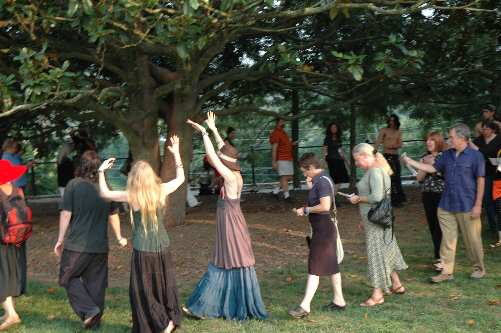
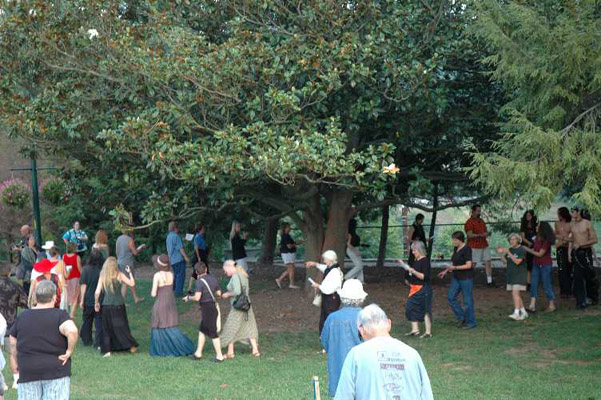
Our protest rite on Lammas, 2007, fascinated the public and media — no one had ever seen anything quite like it before! But it was only the beginning. We fought for nearly a year before starting our stalwart squat — working “in the system” railing against the tree’s demise in endless development-review meetings and stirring up a countywide cauldron of opinion in the process via our hard-hitting commentaries and T.V. interviews.
Election-year sentiments ran high on all sides in 2007 and again in 2008 as "Parkside" became an ever-hotter election issue. Backroom deals, eyebrow-raising campaigns and fat contributions given politicians by Coleman and North Carolina's powerful developer lobby ran rampant throughout the ordeal; each time I thought I’d plumbed its depths, more corruption was revealed, and few officials escaped its taint and the public’s growing ire. Navigating through this milieu was like swimming with sharks. I had no desire to embody the city scold, yet my Pagan belief that a tree older than anyone involved had a right to exist fueled my conviction to persist for the public good. Still, it was blood curdling to realize that I was making multi-millionaire enemies.
What began as a Coven quest steadily attracted admirers and helpers of all persuasions opposed to over-development, sleaze and injustice.
I quit the “legal” rubber-stamping route on July 7, 2008, when a woman whose supposed cause was preserving trees voted in favor of sacrificing the magnolia. I strode angrily out of City Hall and sat down directly across, beneath the tree, vowing not to leave until I’d saved it.
 As a longtime anti-police-brutality activist, I expected to be
immediately arrested. But as the land was technically Coleman’s, the
cops could do nothing without him issuing a trespassing complaint. I
started out with nothing and utterly dependent on food delivered by
whoever pitied me. I was living in a fishbowl in front of the court
house — wide open to the elements, tourists, and judges passing by.
As a longtime anti-police-brutality activist, I expected to be
immediately arrested. But as the land was technically Coleman’s, the
cops could do nothing without him issuing a trespassing complaint. I
started out with nothing and utterly dependent on food delivered by
whoever pitied me. I was living in a fishbowl in front of the court
house — wide open to the elements, tourists, and judges passing by.
I soon became aware that we were fighting not only Coleman, but the County and crazies as well. The descendents of George Willis Pack, who donated the parkland in 1901, were suing the County and Coleman for the sale of land that was supposed to be the public's in perpetuity; some of Asheville’s homeless wanted to use the tree as a flophouse; and fundies drove by at night waving baseball bats and threatening to “Cut ‘er down!”
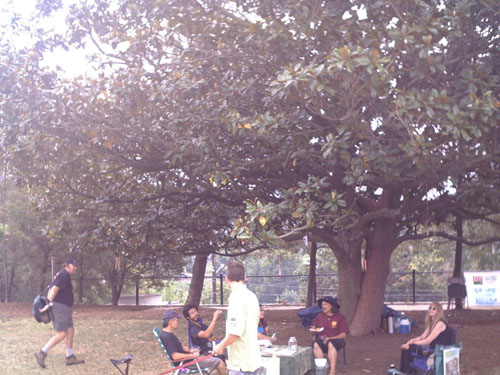
Good-hearted folk who appreciated my sincerity sprang into action and lent me a cell phone, a video camera, water coolers, sleeping bags, and other needful things. *Diuvei and several fellow activists — notably Clare Hanrahan (who'd started sitting beneath the tree every afternoon some weeks before), David Ireland of Copwatch, Bette Jackson, and two homeless men, David and Lemar — took turns making sure I was almost never alone. An activist greenspace-conservation group began a petition that over 9,000 people signed. Save-The-Magnolia T-shirts were printed and became the hip seasonal thing to wear. Rallies, strategy meetings, and direct action training seminars were held, where normally pacifist folks practiced resisting bulldozers.
The tree soon became famous and folks came by the thousands, keenly concerned about the tree’s plight, wanting a photograph before the twin tree’s evocative trunk, or tying a hopeful fetish to a limb. Many times daily I arranged my open-air living room for optimal intimacy — creating sacred space for anyone to “come and sit a spell” beneath Asheville’s liberty tree. I and untold others bonded with the magnolia in the extreme.
I learned every dirty story there was about Coleman and the local officials; enjoyed spontaneous concerts from roving musicians; and got a massage from a passing masseuse. It was a dizzying, ever changing, raging/soothing, heady brew. Nightly, people dropped by to sip ale, congratulate us on the day’s publicity, or to offer thanks and well wishes.
 Because we were camping literally in the front yard of Asheville City
Hall and the Buncombe County Courthouse, nearly everyone who worked
there had to pass by us every weekday — lawyers, judges, officials,
politicians, government workers. We welcomed everyone to talk to us and
sign the petition,
and sooner or later nearly everyone did. Far from arresting us, the
city's
police chief showed off his new Segway to us and told us he supported
what we were doing. A well-known attorney with an office that
overlooked the tree told us if he saw it about to be cut down, he would
fire a flare gun out of his window. A famously conservative city
councilman became one of our most frequent visitors, at first arguing
with and eventually admiring us for our commitment to a principle that
he, too, came to support.
Because we were camping literally in the front yard of Asheville City
Hall and the Buncombe County Courthouse, nearly everyone who worked
there had to pass by us every weekday — lawyers, judges, officials,
politicians, government workers. We welcomed everyone to talk to us and
sign the petition,
and sooner or later nearly everyone did. Far from arresting us, the
city's
police chief showed off his new Segway to us and told us he supported
what we were doing. A well-known attorney with an office that
overlooked the tree told us if he saw it about to be cut down, he would
fire a flare gun out of his window. A famously conservative city
councilman became one of our most frequent visitors, at first arguing
with and eventually admiring us for our commitment to a principle that
he, too, came to support.
The gentility we displayed showed the public the real dichotomy: The Powers That Be might sell public parkland in secret, but we were citizens operating transparently — actively engaged in civil disobedience for all to see. Days stretched into weeks, then months. I clung on, nonetheless, convinced that nothing less than winning would do.
In his hubris, Coleman believed he could use our relentless pressure to coerce officials to buy him out for mega-millions. Growing desperate as the Pack lawsuit loomed, he threatened to cut the magnolia down within 35 days; we responded by calling an immediate Press Conference at the tree, and defiantly rejected his deadline.
On the day the lawsuit came to trial in the County Courthouse, supporters packed the courtroom wearing their magnolia T-shirts, sporting Stop Parkside stickers, and waving flyer fans I’d made. As for me, I sat beneath the tree during two days of Hurricane Fay.
The day before Superior Court Judge Marlene Hyatt was to reveal her ruling, Coleman came armed with a day-glo orange canister and spray-painted the ground with a fence line; I warned him that if he proceeded, he’d need a fence to protect his mansion from public retribution.
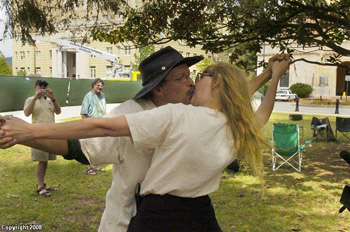
The next day, the judge sided in the people’s favor, and on Sept. 15, 2008, issued her official ruling that the Parkside parcel must remain public land. The merit of my months-long tree-sit had been vindicated — against all odds we’d saved the park, and the tree!
But although I'm back home under my Covenstead roof now, our struggle is far from over. Coleman appealed the ruling, and it will be heard by a different set of judges in far-off Raleigh sometime this summer (2009). The century-old Hayes & Hopson building, also part of the Parkside property, is approved for demolition — and we are working hard to find a donor or investor who will help the County buy the building for renovation as a museum/local-history center or other needed community use.
(Adapted from the article published in Oracle 20/20 magazine, Nov. 2008.)
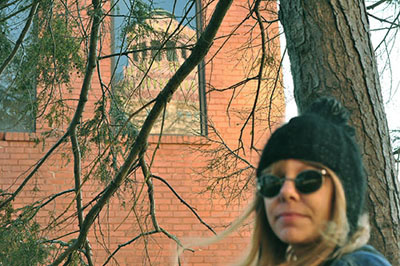
Magnolia Tree Updates:
Summer, 2009:
• Parkside appeal heard; ruling awaited
Read the Asheville Citizen-Times article, "Pack land's fate in hands of state court"; or the Mountain Xpress article, "Parkside appeal heard in Raleigh".
 •
"Magnolia Summer" Art Exhibit
•
"Magnolia Summer" Art Exhibit
The exhibit celebrated the outpouring of beautiful paintings, photographs, and poetry that people spontaneously created, as well as the outraged comments they wrote in a journal during last summer's protracted tree-sit to protect the hundred-year-old twin magnolia on parkland opposite City Hall.
View the exhibit's Online Gallery; or contact Lady Passion to host the exhibit in your gallery or public artspace.
• Saving the Hayes & Hopson Building, and its historic surroundings
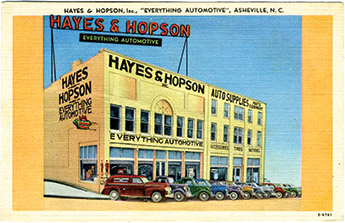 *Diuvei
has been working
with
local & state preservationists -- and Stewart Coleman -- to
save the
Hayes & Hopson building next to the Magnolia tree, which is
part of the Parkside property. One of
downtown Asheville's oldest buildings, the H&H is an important
part of the city's historic fabric, with close ties to our best-known
author, Thomas Wolfe. It is a big (36,000 sq. ft.), sturdy brick
building in excellent condition -- and since it's next door to
Asheville's planned Performing Arts Center, it's in a prime location to
serve
much-needed community purposes such as a heritage-tourism
center/local-history museum, as well as commercial purposes such as a
restaurant or tavern. A few hundred yards away, Mt. Zion Baptist Church
on Eagle St. is threatening to demolish two historic buildings from the
same era that it owns but is having trouble maintaining; *Diuvei has
been involved with an unusual cooperative effort by Asheville
activists, preservation officials, and a City Council member to find
ways to help the church preserve these irreplaceable architectural
resources.
*Diuvei
has been working
with
local & state preservationists -- and Stewart Coleman -- to
save the
Hayes & Hopson building next to the Magnolia tree, which is
part of the Parkside property. One of
downtown Asheville's oldest buildings, the H&H is an important
part of the city's historic fabric, with close ties to our best-known
author, Thomas Wolfe. It is a big (36,000 sq. ft.), sturdy brick
building in excellent condition -- and since it's next door to
Asheville's planned Performing Arts Center, it's in a prime location to
serve
much-needed community purposes such as a heritage-tourism
center/local-history museum, as well as commercial purposes such as a
restaurant or tavern. A few hundred yards away, Mt. Zion Baptist Church
on Eagle St. is threatening to demolish two historic buildings from the
same era that it owns but is having trouble maintaining; *Diuvei has
been involved with an unusual cooperative effort by Asheville
activists, preservation officials, and a City Council member to find
ways to help the church preserve these irreplaceable architectural
resources.You should know the bad news and the good news:
- Bad news: Legal protections for historic buildings in N.C. are few. A city can stave off demolition for six months only, and only if the building is in a Local Historic District -- but no other designation can stop the building's owner from demolishing it, not even if it's listed on the National Register of Historic Places.
- Good news: There are plenty of voluntary financial incentives for preservation, including tax credits (which can reimburse owners up to 40% of the cost of renovating a historic property) and preservation easements (which are the equivalent, for historic buildings, of the conservation easements that WNC farmers are increasingly using to protect their family farms forever from being lost to overdevelopment). Find out more from Preservation North Carolina.
• Historic Landmark Status for Magnolia Tree
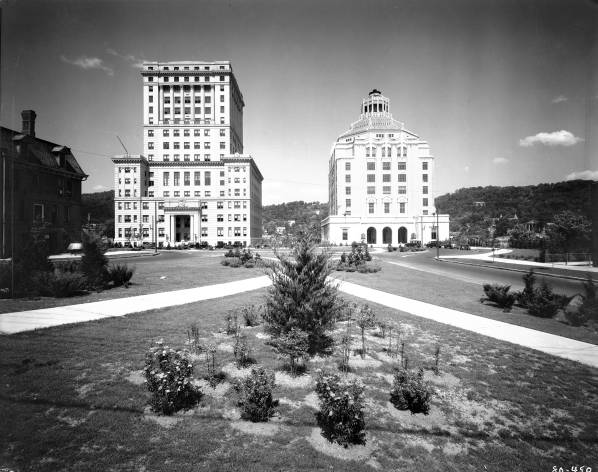
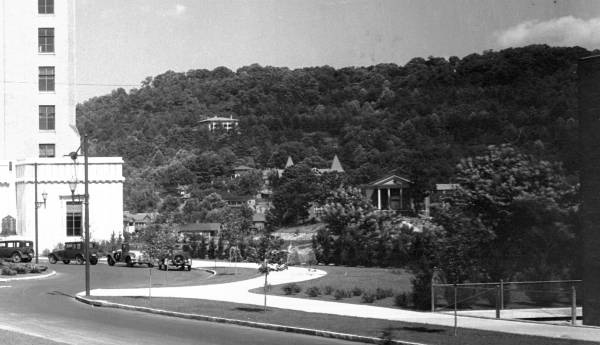
| The magnolia tree -- already mature -- is on the far right of this ca. 1929 photo by E.M. Ball, below left, as the detail view clearly shows, below right. Note the antique cars parked in front of City Hall. (Source: E.M. Ball Collection, UNCA Special Collections, identifier: ball1635.) | |
 |
 |
• Citizen Appeal of Development Approval
"We need a level playing field on development issues" is a commentary by *Diuvei (Steve Rasmussen) published in the Asheville Citizen-Times, Wed., July 22, 2009 that advocated for:
- the Pack Square zoning amendment that city planning staff
have drawn up at City Council's request, which would require that any
significant development proposals adjoining Pack Square be subject to
public input and City Council review;
- Read news article about this.
- Please attend Planning & Zoning Commission review of this, Thursday, July 23, 2009, 4 p.m., First Floor, City Hall
- including the right for citizens to appeal a
flawed development approval in the Master Plan's revision of
the city's ordinances.
- Read more information, including the wording proposed to City Council, how N.C. state law allows it, and how other cities incorporate the right to citizen appeal into their development ordinances.
Fall, 2009:
• A victory toast to "Pack's Tavern"!
"The first step toward creating the future is discovering the past."
From a dream *Diuvei had on July 28, 2009. Several days later, on August 3, 2009 — the anniversary of our Lammas protest rite under the magnolia trees — we learned from a WLOS-TV news report that Stewart Coleman planned to restore the Hayes-Hopson building and turn it into "Pack's Tavern".
Developer Stewart Coleman has officially withdrawn his plans for the Parkside condos. And he is not, as of now, demolishing either the magnolia tree or the Hayes & Hopson building.
Instead, he is preserving and renovating the building, and turning it into "Pack's Tavern" — a bar and restaurant that will feature 40 taps serving local Buncombe brews. (Recently dubbed "Beer City, USA," Asheville now boasts more locally manufactured ales than any other city in America.) Pack's Tavern is expected to open early in 2010. And the now-famous magnolia tree will, it appears, be one of its attractions.
The change of course followed in the wake of discussions *Diuvei initiated after the tree-sit between Coleman and respected local and state preservationists; we all toured the building together, and the preservationists (including William "Buncombe Bill" Wescott and representatives of Preservation North Carolina) pointed out the valuable features of the Hayes & Hopson.
We've achieved a unique victory: We not only stopped a major developer and saved both a natural and a historic landmark — we also succeeded in helping him find a better, more community-oriented (while still profitable) use for the property. (After all, wise activists don't just oppose — they also propose.)
Our public responses:
"Local resident Steve Rasmussen, who was involved in protests of the condo proposal, said Tuesday that he was 'thrilled' to hear of plans for Pack's Tavern.
'I'm going to be there on opening day,' he said. 'This is what people want. (Coleman) is doing the right thing. ... People ought to make it a great nightspot.'
'This is what we wanted all along is to save the historic building and the tree,' he said, referring to a large magnolia on the park property that became a focal point of protests.
Rasmussen said he would still like to see measures to permanently protect the tree and the Hayes & Hopson.
— "Pack Tavern part of plan B," by Mark Barrett, Asheville Citizen-Times, Aug. 5, 2009
"'We're thrilled,' exclaimed Dixie Deerman, one of the protesters who participated in a vigil under the threatened magnolia tree. 'We're glad he's done the right thing.'
Preservation of the Hayes & Hopson building was likewise a happy outcome, she said, but the fact that the Parkside project got so far along indicated that the city's development rules need an overhaul.
— "The end of Parkside: Coleman withdraws condo project," by David Forbes, Mountain Xpress, Oct. 21, 2009
At this writing (Oct. 24, 2009), *Diuvei is serving on the Urban Design/Development Committee for the Asheville Downtown Master Plan, in order to ensure that the flaws in the city's development-review process that have led to the kind of run-amok development Parkside symbolized are rectified — and to ensure that Lady Passion and he will never have to spend another summer camped out in front of City Hall.
Winter, 2009-2010:
Asheville Downtown Master Plan Hotspots: Interview with Steve Rasmussen on "Listen Local," hosted by Veronika Gunter on AshevilleFM.org

Aired: Dec. 17, 2009, 7 pm
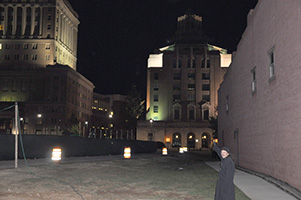

[As previewed on scrutinyhooligans.us]: "Veronika Gunter will interview Parkside activist Steve Rasmussen for the inside story on what's going on with Asheville's Downtown Master Plan. A member of the Master Plan's Urban Design/Development Action Subcommittee, Rasmussen has been meeting weekly with city staff and downtown developers as the group hashes out how to turn the development-control recommendations of the Master Plan into law. He'll discuss what he sees as the key points citizens concerned about development issues will need to zero in on as the finalized Plan makes its way to City Council — what he calls 'Master Plan hotspots' of likely controversy."
*Diuvei (Steve Rasmussen) also outlines in easy-to-understand terms the Master Plan's downtown-development reforms, which are designed to preserve Asheville's lively streetscape and prevent massive "concrete canyon" buildings.
(Technical note: A minor 3-second omission followed by a change in volume occurs at 17m24s in this recording when the digital recorder was switched from microphone to jack input.)
~ MP3 Audio Files ~
- Master Plan excerpt (02m 07s)
- Master Plan interview, 20.9MB (45m 48s)
- Master Plan interview, 41.9MB (45m 48s)
Spring, 2010:
• Pack's Tavern opens
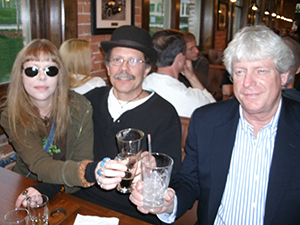
Lady Passion and *Diuvei attended the opening day of Pack's Tavern on April 19, 2010 (exactly a year after the opening of the "Magnolia Summer" Art Exhibit) and raised a toast with Stewart Coleman just a few yards from the magnolia tree where they'd camped in protest two years earlier. The preservation-focused team of local professionals Coleman hired to renovate the Hayes-Hopson in the style of a 1920s speakeasy won the project a prestigious Griffin Award from the Asheville Preservation Society.
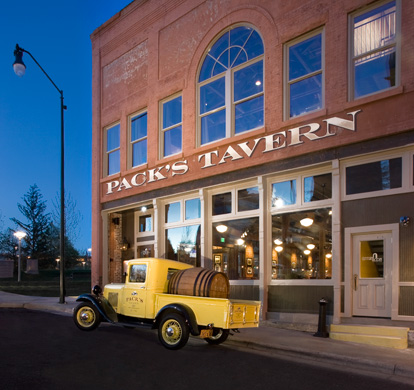
Coleman had researched and acted on one of Lady Passion's suggestions under the tree — to turn the building into a "people's tavern" — and at a historic-preservation event held a few months later at Pack's Tavern, he privately thanked *Diuvei for saving him from bankruptcy. If our stubborn protest had not prevented him from building the Parkside project, Coleman said, he would have been stuck deep in debt with a luxury condo project right when the Great Recession struck and wiped out the luxury housing market. Instead, Pack's Tavern was proving so successful that Coleman told *Diuvei he planned to open a similar franchise in historic Charleston, South Carolina.
Winter, 2010-2011:
• Asheville's Haunted History Museum
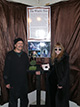
On Dec. 3, 2010, Lady Passion & *Diuvei blessed the Asheville Tourism Center & Free Museum, downtown's first-ever history museum (with a spooky twist), newly opened by Joshua Warren in the "underground jail" beneath the Magnolia Tree that Coven Oldenwilde saved. Its "The Witch's Tree" exhibit illustrates the tree-sit — and includes a spell donated by Stewart Coleman!
The spell, comprising a black candle, a small corked bottle originally filled with liquid, and a parchment scroll, was given to Coleman by a supporter who claimed it would protect him from the Witches' "curse". Coleman told Joshua that he never used it, but we did notice that the bottle has been drained and the candle burned ... The spell is visible in the photo shown here, next to Lady Passion. (Also note the spirit orbs!)
(UPDATE: The museum has since moved to the basement of the Asheville Masonic Temple on the corner of Broadway and Woodfin. To schedule a visit, see http://www.facebook.com/mysterymuseum. As of 2012, Pack's Tavern is installing an in-house brewery in the underground jail ... which ought to make its resident ghost quite happy!)
- About the Museum
Asheville Ghosts of Christmas Past & More at Free Museum
[Press release from Joshua Warren] Asheville, N.C. (December 8, 2010) -- Asheville native Joshua P. Warren has finally opened his Tourism Center & Free Museum, featuring our city's most unusual and extreme history. Displayed inside the "Old Jail & Gallows" building behind Pack's Tavern, 20 South Spruce Street, much of the content is dark and strange, including local criminology and spooky stories. As the author of 12 books, including the regional best-seller "Haunted Asheville," Warren feels it's about time our city's quirky and mysterious side is properly presented.
"People who have lived here a lifetime will not know most of this," Warren grins. "My friends and I have spent years compiling stories that make Asheville look like a small Ripley's Museum."
On display is a life-size recreation of "The Dook," a mummified con-artist who was paraded around town twice a year in the early 1910s, including Christmas time. There is a blow-up of the bullet-riddled corpse of Will Harris, who committed the city's largest mass murder. A model of the Battery Park Hotel reveals the Helen Clevenger murder room, from 1936. Displays present clear facts regarding the gallows, bootlegging, Brown Mountain Lights, WW2, Civil War, and "The Witch's Tree," a magnolia at the center of great controversy when developer Stewart Coleman debated local Wiccans. Special sections of the Museum include a small theater where one can munch popcorn and view clips from Asheville's first movie, shot in 1921; a room with the world's only life-size model of the creepy Newby Phantom; and a small chamber, called a "psychomanteum" designed for spiritual communication with "the other side." ...
The Museum is usually open around noon each day, but given the erratic, off-season hours, Warren suggests guests email or call before visiting. His website is www.AshevilleTourCenter.com and questions can be answered at (828) 335-6764. The Museum is in the 1920s gray, rock building, with barred windows, behind Pack's Tavern. ...
- Photo Gallery
Winter, 2011-2012:
• Rest in peace, Stewart Coleman
We were shocked and deeply sorry to learn that Stewart Bryan Coleman died of a chronic illness on Sunday, January 29, 2012, in Charleston, S.C. Although we began our relationship with Stewart as enemies on opposite sides of what became an epic political battle over the future of Asheville, we and he found our way to common ground and to collaboration for a greater good. In the end, we respected Stewart and counted him as a friend. We send our prayers and blessings with him into the Summerland.
Summer, 2014:
• Covenstead's Magnolia seedling
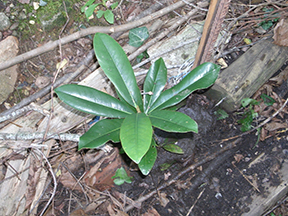

This seedling (at left) was given us by a neighbor of the new Harris Teeter on Merrimon Ave., Asheville, where a well-known magnolia (at right) formerly grew on the site of what once was the George W. Pack mansion "Manyoaks". This is probably a descendant of that magnolia.
 Go to
Go to  Return
to Coven Oldenwilde's home page
Return
to Coven Oldenwilde's home page