
|
Five Points of Fellowship
If the United States of America was founded as a "Christian" nation, then why do we wave a Pagan-pentagram-spangled banner?
Because the five-pointed star that nowadays represents the U.S.A. is an ancient symbol for the whole, harmonious human being, which Masons transmitted from the oldest occult tradition into the iconography of freedom.
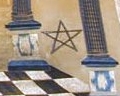 Pentagram on George Washington's Masonic apron
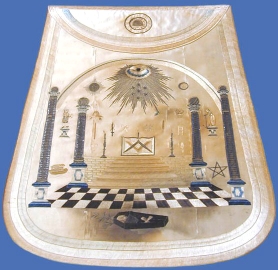
America's founding pentacle may well be the one in the lower right corner of George Washington's symbol-spangled Masonic stonecutter's apron. The Marquis de Lafayette presented this ritual garment to Washington in 1784 -- just after the end of the war for self-determination that the Frenchman had helped the Americans win, and shortly before Lafayette went on to help spark the French Revolution. Like so many of the revolutionaries on either side of the Atlantic who fought to become citizens rather than subjects, both Washington and Lafayette were initiates of the international fraternity of Freemasonry .
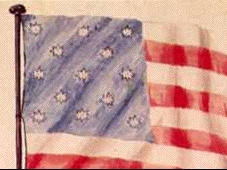
Early American flags:Above, Flag of the "Alliance" at The Texel Holland (painting). Dutch; 1779 Oct. 4; Original at the Chicago Historical Society.
Below, Guilford Court House Flag. American; 1791-1792? Original at the North Carolina Hall of History.
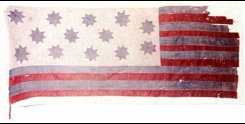
The stars on the American flag didn't start out as pentagrams. In 1777, the Continental Congress resolved that the flag's "union be thirteen stars, white in a blue field, representing a new Constellation" of independent but united states. At that time, stars in heraldryIn British heraldic convention, a star of five points is termed a "mullet," and usually represents the rowel of a spur. A star, per se, is termed an "estoile," and has at least six points, usually wavy. and art were conventionally depicted with an arbitrary number of points, from four to eight or more, representing rays of light. And that's just how flagmakers often made them until well into the 1800s, as historical examples such as these show.
Support Coven Oldenwilde,
a 501(c)(3) religious nonprofit:
 Find out if they’re LYING. Lady Passion KNOWS if your spouse ... family ... lawyer ... boss ... employee ... juror ... doctor ... -- anyone -- is telling you the truth. Consult her NOW!
But starting in the post-Revolutionary "Federalist" period of American history -- as the developing idea of the "United States" crystallized around certain symbols -- pentacles of five points began to appear all over the place. American artists and craftspeople not only embroidered them on flags, but molded them on buildings, carved them into furniture, painted them on walls, stitched them into quilts, applied them to seemingly every surface they decorated. Why?
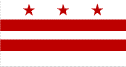 Washington, D.C., Flag
Not because Betsy Ross showed George Washington, who supposedly wanted six-pointed stars on the flag, how she could make a five-pointed star with one magic snip from a folded piece of cloth -- a legend that one of Betsy's descendants admitted to inventing long after her death. Washington actually used pentagrams on his own family coat of armsMany vexillologists (scholars of flags) believe Washington's arms influenced the design of America's "Stars and Stripes." Others believe it derived from the military standard of Great Britain, a Union Jack in the upper corner of a field of red (cf. Canada's former flag). Both may be true; but as pointed out here, the convention of representing the flag's stars specifically as pentagrams did not develop till the early 19th century, when American Masons made the symbol prominent., as you can see on the flag of the District of Columbia, which reproduces his arms, and on artifacts at his home in Mount Vernon. Yet the magical seamstress's secret that links a famously skilled craftswoman -- who during her career did sew what must have been thousands of stars onto flags for the Philadelphia Navy Yard -- with the Masonic Founding Father reveals a glimmer of the true origin and meaning of the American pentagram.
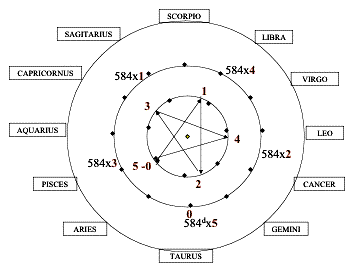 Venus's orbit through the zodiac traces a pentagram.
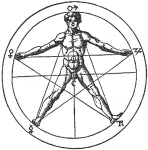 Agrippa's man & pentagram
The symbol Masons call the "Eastern Star" (or sometimes "Blazing Star") is as ancient as the planet Venus, whose conjunctions with the Sun trace a near-perfect pentagram on the circle of the zodiac. It has borne many meanings since the Stone Age, when it was incised as rock art in the pre-desert SaharaThe Serer people of Senegambia, believed to be the descendants of these rock artists, still venerate the pentagram as the "Star of Yoonir", symbolizing the Universe. See http://en.wikipedia.org/wiki/Serer_religion.. To the Egyptians, the pentagram was the hieroglyph of "night;" to the followers of Pythagoras, it was the sacred symbol of wholeness and health. In the Middle Ages, it was often associated with the magical wisdom of King SolomonThe "Testament of Solomon," one of the oldest magical texts attributed to Solomon -- dating from the 1st-3rd century AD -- depicts King Solomon as using a ring engraved with a pentagram to control demons and compel them to help his workmen build the Temple., and carved as "Solomon's Seal" on churches, mosques, and synagogues as protection against inhuman forces. It appears in medieval grimoires and spellbooks as a magical blessing and ward -- as it is still for modern Witches. As a symbol of truth, Sir Gawain bore the interwoven "Endless Knot" pentagram on his shield in the Arthurian legends. As a symbol of the human body, mystical Christians linked the pentagram to the Five Wounds of Christ; and the Renaissance occultist H. Cornelius Agrippa showed how it incorporates the "golden mean" pattern on which the body is proportioned.
The pentagram thus had a long, rich history of associations with humanity, magic, and wisdom by the Age of Enlightenment, when Freemasonry -- a self-described "peculiar system of morality veiled in allegory and illustrated by symbols" that branches directly from the same tree of knowledge as Witchcraft -- adopted it to represent its ethical code of fraternity, the Five Points of Fellowship. From the earliest Masonic manuscripts onwards, these Five Points have been ritually connected with five points on the human body -- very similar, though not identical, to Traditional Witches' Fivefold Kiss.
Like Witches, Masons are heirs to the magical and metaphysical wisdom of antiquity that was preserved during the Middle Ages and revived in the Renaissance, then driven underground in the Burning Times of the 16th and 17th centuries -- till it re-emerged in the new scientific and revolutionary circles of the 17th- and 18th-century Enlightenment. The main differences between the two "Crafts" were those of class and gender. Whereas a classic Witches' Coven was a gathering of the female and male healers, herbalists, and midwives of a poor rural village, a classic Masons' Lodge was a male-only meeting-place for the many specialized middle-class artisans and tradesmen -- architects, goldsmiths, glassblowers, stonecutters, and so on -- who would come together in a city to build and ornament a cathedral or palace.
Masonry's popularity spread during the 1700s because -- by contrast to orthodox Christianity -- it tolerated all religions, encouraged science, and recognized the magic ennobling common workingman's tools such as trowels and squares and mallets. This international fraternity of the bourgeoisie directly opposed -- and collaborated to overthrow -- the repressive ecclesiastical and aristocratic hierarchies that claimed dominion by Divine right over the American Colonies and France.
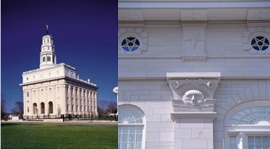
The point-down Masonic pentacles framing the entablature windows on the reconstruction of the original Church of Jesus Christ of Latter Day Saints temple in Nauvoo, Illinois have caused a minor flurry among fundamentalists. (The face carved on the capital represents the Sun.) But the fallacy that an inverted pentagram is a sign of the Devil originated with the 19th-century occultist Eliphas Levi.

The inverted pentacle (which Gardnerian Wiccans use to symbolize our second initiatory degree) has since ancient times signified the "Eastern Star" — Venus appearing just before dawn, with Her downward-pointing ray promising the soon-to-rise Sun. The Order of the Eastern Star, a co-Masonic order that is open to women as well as men, uses the inverted pentagram as its symbol. And Christians have traditionally often used the point-down pentagram to represent the Star of Bethlehem, the "star in the East" that pointed the Wise Men to the baby Jesus's birthplace, as well as to signify St. John the Baptist, who heralded the coming of Christ just as the Morning Star heralds the rising Sun.
Still, modern fundamentalist Christians — along with hack Hollywood scriptwriters — insist on attributing a Satanic meaning to the symbol. Playing along with the stereotype, Anton LaVey adopted the inverted pentagram in the 1960s as a logo for his Church of Satan (which actually neither worships nor believes in Satan):

It's surprising, then, that the Republican Party, whose power depends on fundamentalists' support, has used inverted pentacles in one of its most commonly seen logos since the 2004 election — and even more surprising that hardly any fundamentalists seem to have noticed:
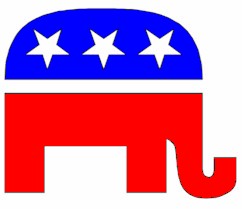
In the decades after the American Revolution, Freemasonry and its spin-offs, such as the Odd Fellows and Elks, swept the new nation like a prairie fire. (The Mormons also began as a Masonic lodge; and their founder, Joseph Smith, was an avid practitioner of Pagan magic.) These brotherhoods helped glue together the miscellaneous prospectors, sodbusters, and cowpokes who emigrated to the frontier from myriad cultural and religious backgrounds, and provided a source of official symbols and rituals for newly established institutions. (The judge's gavel, for example, derives from the Masonic Lodge Master's mallet -- which symbolizes the power to hammer rough, lawless stones into smooth, obedient blocks.)
True, fellowship may not have been at the forefront when two rival Masonic orders struggled for control of Mexico in the 1820s and 1830s, till Santa Anna seized power as dictator -- by turning coat from the left-wing York Rite Masons ("los yorkinos") to the right-wing Scottish Rite Masons ("los escoceses"). York Rite Masons in Texas, who had been among the first Americans to settle in the territory, thereupon instigated the revolution to "liberate" Texas from the Mexican Master Mason. In 1837, following Santa Anna's defeat by General Sam Houston, the Texas Masonic lodges gathered in the new republic's Senate Chamber as newly elected President Sam Houston presided over the founding of the Grand Lodge of the Republic of Texas.
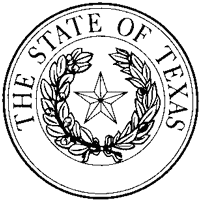 Pentagram in a victory wreath on the seal of the "Lone Star State"
The victorious Texans adopted the five-pointed Masonic symbol of fellowship as the emblem of the Texas Republic -- and eventually of what we now, somewhat paradoxically, nickname the Lone Star State.
In 1844, when Texas was an independent republic but not yet a state, George K. Teulon wrote in Freemasons' Monthly Magazine:
"Texas is emphatically a Masonic Country; all of our Presidents and Vice-President, and four-fifths of our State Officers were and are Masons: by Freemasonry to illustrate the moral virtues -- it is a Five Pointed Star ... May it ever bind us in the holy Bond of Fraternal Union and govern our social, Masonic, and Political intercourse."
 Texas Flag
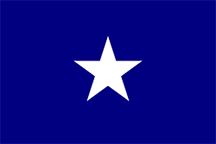 Bonnie Blue Flag
The Lone Star flag was directly inspired by the pentagram flown by an earlier group of American-born Freemasons who led a rebellion against Mexico and founded the short-lived "Republic of West Florida":
"In 1810, a group of prominent planters, all Freemasons, gathered in Bayou Sara near St. Francisville, and adopted a plan of government for Spanish West Florida -- an area from the Perdido River to the Mississippi River and South of the 31st Parallel. In September, the Fort at Baton Rouge fell and the Republic of West Florida was declared to be sovereign. The blue banner with the single white star in the middle, symbolizing the five points of fellowship under which the ringleaders met, was adopted as the official flag of the Republic. The flag would later be used in the Texas Rebellion ..." (From The Development of Scottish Rite and its Leadership in Louisiana Freemasonry, by William J. Mollere, P.M.)
The Republic maintained its independence only 74 days, till President James Madison (himself a Mason) annexed it into the Louisiana Territory. But its banner lived on as the "Bonnie Blue Flag" celebrated in a well-known Civil War marching song, and was often flown as an unofficial flag of the Confederacy.
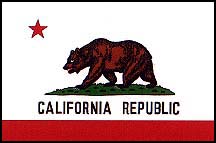 California Flag
The Lone Star and the Bonnie Blue inspired the pentagram on California's "Bear Flag" when Americans there followed the example of Texas and West Florida, and rebelled from Mexico to found a short-lived republic, just before the Gold Rush. The star under which Davy Crockett, Jim Bowie, and their comrades died at the Alamo must have been very influential in popularizing the pentagram as the star of America, which it had largely become by the time Union and Confederate armies alike bore it on their battle standards in the Civil War. (Folk flagmakers still sometimes used other stars, however. The federal government didn't standardize the pentagram as the U.S. star until 1912.)
 "America" |
|
 USA (Great Star flag) |
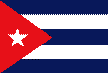 Cuba |
 "Communism" |
|
 USSR |
 North Korea |
 "Islam" |
|
 Iraq |
 Morocco |
So it came about that when the middle-class "capitalists" began to struggle with the proletarian "communists" to decide which would be the new dominators of the planet, the capitalists bore the white pentacle of America's flag as their badge, while the communists bore a red pentacle as theirs. The five-pointed Red Star of communism symbolizes the worker's five-fingered hand, reddened with the blood of struggle.
Pentagrams colored green, a color sacred to Islam, appear on the flags of many modern Islamic nations. After the U.S. invaded Iraq, the citizens of that country refused to give up their green-pentacled flag for a new light-blue flag their occupiers briefly attempted to impose on them. In a quagmire of ironies, Iraqi insurgents who waved Islamic-green pentagrams on a white background fought for liberty by attacking their self-styled American liberators' tanks and Humvees, which bore a white pentagram on an Army-green background.
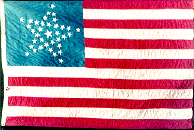
Though Lady Passion's and my favorite design, this Great Star flag has a sorrowful history: It has been carried in mourning at the state funerals of assassinated American Presidents from Lincoln to Kennedy.
I find it tragic that this universal star of humanity so closely associated with Venus, the astrological ruler of love, harmony, and cooperation, is nowadays so commonly degraded into a unilateral star of nationalism, stained by martial violence and competition. Where in this supposedly "patriotic" logo is the fraternal spirit of E Pluribus, Unum -- From Many, One?
But I find some hope in this: Today,
two centuries after the Masonic movement constellated the pentagram
throughout the world as a symbol of man's bonds with other men,
the rapidly growing Wiccan movement is seeding the planet with
its star -- the encircled, interwoven "Endless Knot"
pentagram -- as a symbol of humanity's bonds with all of Nature.
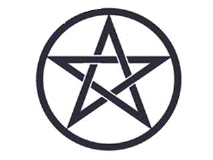 The "endless knot" pentagram that, when in a circle, symbolizes Wicca also has many occult, spiritual, and mystical correspondences
- For example:
- Sacred geometry: Its three line lengths are interrelated by the Golden Proportion (Fibonacci series).
- Wicca: Its points correspond to (clockwise from top point) the Elements Spirit, Water, Fire, Earth, Air.
- Omraam Mikhaël Aïvanhov: Its sides represent (clockwise from horizontal side) the Virtues Wisdom, Truth, Goodness, Love, Justice.
- Baha'i: As an official symbol of this universalist faith, it is the haykal, Arabic for "temple" or "body", symbolizing the head and four limbs.
- Serer religion: The top point is the supreme Deity, Roog, and the other four are the cardinal directions.
 To learn more about
the fascinating history and rich symbolism of the Pentagram, explore
these links:
To learn more about
the fascinating history and rich symbolism of the Pentagram, explore
these links:
 http://www.thornr.demon.co.uk/kchrist/pent.htmlhttp://freemasonry.bcy.ca/anti-masonry/pentagram.html
Patterns in Venus transits
http://www.thornr.demon.co.uk/kchrist/pent.htmlhttp://freemasonry.bcy.ca/anti-masonry/pentagram.html
Patterns in Venus transits

To read more writings on everyday esotericaEverywhere you look, ancient mysteries are hidden in plain sight. by *Diuvei (Steve Rasmussen, author of this page) and Lady Passion (Dixie Deerman):
- Explore deeper in Coven Oldenwilde's Wiccan Website;
- Read The Goodly Spellbook: Olde Spells for Modern Problems;
- Discover more about America's Pagan Heritage through these links: